

Blueprint for an Intentional, Measurable AI Culture at Sanguine
Kevin Chern
From Hype to Impact: Building a Measurable AI Culture at Sanguine
Most teams are hearing the same message about AI right now: “Move fast or get left behind.” The result is usually chaos and the opposite of building an AI culture. People test tools in silos. Leaders see screenshots instead of real metrics. A handful of enthusiasts carry the load while everyone else quietly opts out.
At Sanguine, we’re taking a different path.
We’re treating AI not as a shiny object, but as an operating system for how we work together. That means grounding everything in measurable time savings, transparent workflows, and a culture where people feel safe experimenting – and safe saying, “I don’t know how to do this yet.”
This post walks through how we’re doing that, the systems we’re putting in place, and a practical blueprint you can borrow for your own organization.
1. Start with a simple promise: 1 hour per week
Our AI culture doesn’t start with technology. It starts with a simple, concrete promise:
Everyone should gain at least 1 hour per week back through AI.
Not in theory. On the calendar.
We chose 1 hour because:
- It’s small enough to feel realistic for busy people.
- It’s large enough to be meaningful when it compounds.
- It shifts the conversation from “AI is cool” to “AI is helping me today.”
From there, the math gets interesting:
- Week 1: 1 hour saved.
- Week 2: Another hour.…
- Week 11: ~11 hours saved per week.
- Over a year: easily 500+ hours per person reclaimed for higher‑value work.
We talk about this openly in the company. When people see AI as a way to reclaim attention and reduce cognitive load, resistance drops and curiosity increases.
2. Make Notion the “office floor” – and AI the layer on top
We use Notion as our single source of truth – the digital equivalent of the office floor. Meeting notes, playbooks, roadmaps, experiments, metrics: they all live there.
Why this matters for AI:
- AI is only as good as the information it can see.
- If knowledge is scattered across Google Docs, email threads, and slide decks, you get shallow answers and hallucinations.
- When information is structured in one place, AI can finally behave like a real teammate instead of a party trick.
So our principle is:
Organize first, automate second.
We:
- Capture meetings directly in Notion with recordings and transcripts.
- Route decisions, frameworks, and working docs into shared team spaces.
- Treat Notion as the canonical layer for “what we know” and “what we decided.”
Only after that do we start layering AI on top in the form of agents and workflows.
3. Use agents to reduce repeat questions, not replace people
A lot of AI programs start by trying to replace whole roles. We’re more interested in removing friction and repetition so people can do more of the work only they can do.
Two concrete examples from our environment:
a. The HR-style Q&A agent
We built an internal HR-flavored agent that answers questions like:
- “What’s our PTO policy?”
- “How do I submit an expense?”
- “Where do I find the reimbursement form?”
Instead of:
- Slacking someone in Operations.
- Waiting for them to come out of a meeting.
- Re‑asking the same question that’s been answered 20 times.
The agent:
- Pulls from the right Notion spaces (HR docs, internal FAQs, policy channels).
- Responds in Slack when mentioned or tagged.
- Surfaces the exact policy or form link.
Outcome:
- Fewer interruptions for the people who own the process.
- Faster answers for the person with the question.
- A tight feedback loop: if the agent struggles, we know documentation is missing or unclear.
b. The onboarding and reporting assistant
Another agent focuses on customer onboarding and progress reporting. Instead of recurring, ad‑hoc check‑in meetings just to share updates, this agent can:
- Look across onboarding databases, activity logs, and retrospective notes.
- Compile a concise progress summary for a customer or program.
- Answer follow‑up questions like, “What’s blocking this account right now?”
This is more than convenience. It changes how leaders spend their time. Ten‑minute status meetings can turn into two‑minute Slack threads, and the remaining eight minutes go to problem‑solving instead of fact‑finding.
4. Turn meeting transcripts into a living knowledge base
We record and transcribe key meetings into Notion, including:
- Customer calls.
- Internal strategy discussions.
- Enablement and training sessions (like AI Lunch & Learn).
Those transcripts aren’t just archives. They’re inputs to how we:
- Onboard new teammates.
- Coach connectors and operators.
- Design repeatable playbooks.
With AI on top of this foundation, someone can ask:
- “Summarize the last 10 attorney lead‑curation calls our team ran.”
- “What solution patterns do we usually recommend when a firm struggles with intake follow‑through?”
- “What objections do we keep hearing about this particular solution?”
Instead of:
- Calling a teammate to “download” what they remember.
- Re‑listening to recordings.
- Hunting through half‑finished notes.
The system surfaces patterns directly from real conversations, across roles and business units.
5. Design personal workflows, not just team workflows
A healthy AI culture is bottom‑up as well as top‑down. We want individuals to experience tangible wins, not just hear about big vision.
One of our favorite patterns is a personal morning brief. A simple version looks like this:
- Every morning at a set time, an agent runs for a given person.
- It reviews yesterday’s meetings, tasks, and notes.
- It compiles:
- What you accomplished yesterday.
- What’s still open or at risk.
- What’s on your calendar today.
- Suggested top priorities.
When the team gathers for standup, you’re not scrambling to remember what happened. You’re reviewing and adjusting a draft that’s already done.
The benefits are both emotional and operational:
- Less morning cognitive load.
- Fewer “I forgot about that” moments.
- A default habit of starting the day with intention, not inbox chaos.
6. Set guardrails: where agents can and cannot look
One of the most important culture choices we’ve made is being opinionated about where agents look for answers.
In theory, you can give an agent access to everything. In practice, that:
- Decreases accuracy.
- Increases the risk of hallucinations.
- Makes it harder to debug strange outputs.
So we:
- Point each agent to specific Notion spaces that match its purpose.
- Add only the Slack channels that are relevant for that workflow.
- Avoid mixing unrelated domains (for example, we don’t blend deep roadmap docs for one product with HR policy for an HR bot).
This has two cultural side effects:
- Teams get more thoughtful about how they organize their workspaces.
- When an agent answers incorrectly, it’s usually a content or scoping issue we can fix, not a mysterious black‑box failure.
7. Normalize experimentation – and debugging
We actively encourage people to:
- Build personal agents for their own workflows.
- Share what worked and what broke.
- Treat early versions as prototypes, not production systems.
Tools like the Activity tab and “Improve this agent” flows are not just technical features. They are culture tools:
- They make it safe to admit, “This isn’t working the way I expected.”
- They shift the mindset from “I’m bad at AI” to “This is just another system we can iterate on.”
We celebrate:
- People who try a new agent template.
- Teams who pressure‑test an internal bot by trying to “break” it.
- Stories where an agent saved someone an hour – and what they did with that time.
8. Measure impact in human terms, not just throughput
Yes, we care about traditional metrics:
- Tasks completed.
- Time saved.
- Tickets answered.
But we also pay attention to human indicators:
- Are people interrupting each other less for repeat questions?
- Do new hires feel they can get up to speed faster using our knowledge base and agents?
- Are cross‑functional teams more aware of what others are working on?
Internal and external research both point to the same conclusion: when teams pair well‑structured information with AI, it’s realistic to see 65–75% efficiency improvements in certain workflows, even as you grow headcount.
The key is to keep asking:
Where did this save us time, attention, or frustration – and how can we amplify that?
9. A practical blueprint you can copy
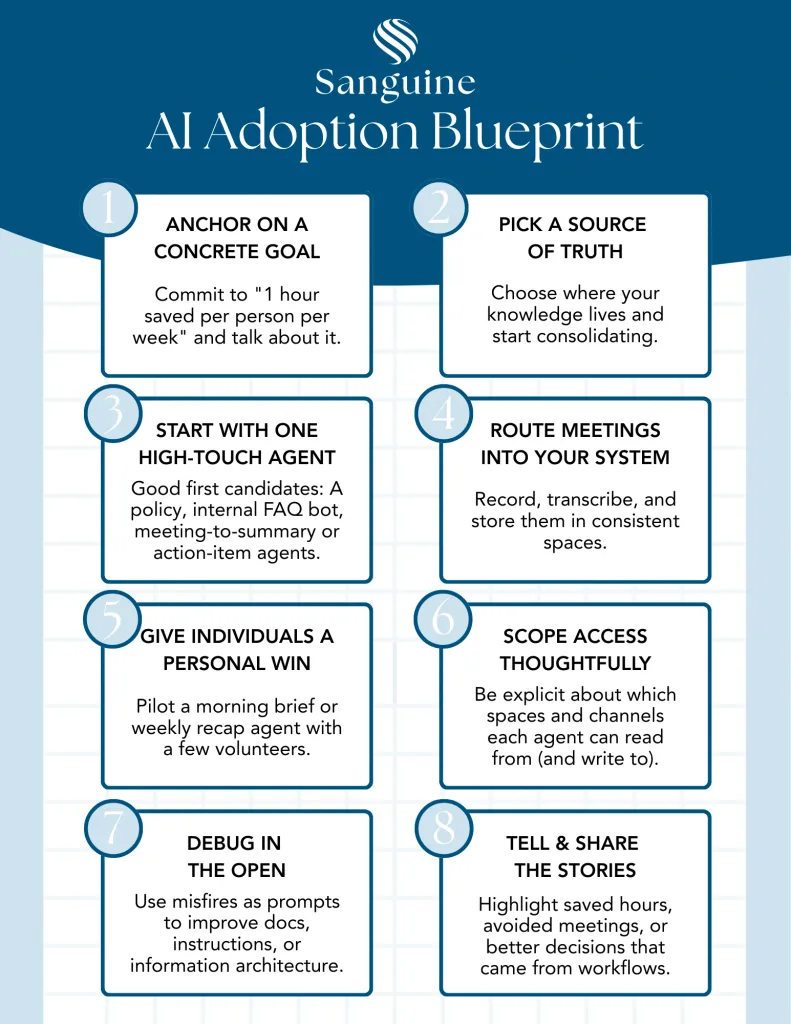
If you’re building your own AI culture, here’s a simple starting blueprint inspired by what we’re doing:
- Anchor on a concrete goal. Commit to “1 hour saved per person per week” and talk about it openly.
- Pick a source of truth. Choose where your key knowledge lives (for us, it’s Notion) and start consolidating.
- Start with one or two high‑leverage agents. Good first candidates:
- A policy / internal FAQ bot (HR, finance, IT).
- A meeting‑to‑summary / action‑item agent for recurring calls.
- Route key meetings into that system. Record, transcribe, and store them in consistent spaces.
- Give individuals a personal win. Pilot a morning brief or weekly recap agent with a few volunteers.
- Scope access thoughtfully. Be explicit about which spaces and channels each agent can read from (and write to).
- Debug in the open. Use misfires as prompts to improve documentation, instructions, or information architecture.
- Tell the stories. Share examples of saved hours, avoided meetings, or better decisions that came from AI‑augmented workflows.
10. Where we’re headed next
We see AI as a long‑term capability, not a one‑time rollout. For us, “intentional AI culture” means:
- Being clear about what we want AI to do – and what we don’t.
- Investing in shared structures and language so agents have good raw material.
- Giving everyone tools and coaching to design their own workflows.
- Measuring success in both operational and human terms.
If you’re building something similar, you don’t need to copy our stack or our org chart. What matters is that you:
- Choose a clear, human‑sized starting point.
- Keep your knowledge organized.
- Treat AI as a teammate you’re training over time.
That’s how you move from hype to measurable impact – and build an AI culture people actually want to be part of.
Tags:
TRENDING POSTS

How Law Firms Harness the Power of AI

Your January Business To-Do List That Can’t Wait Until February