
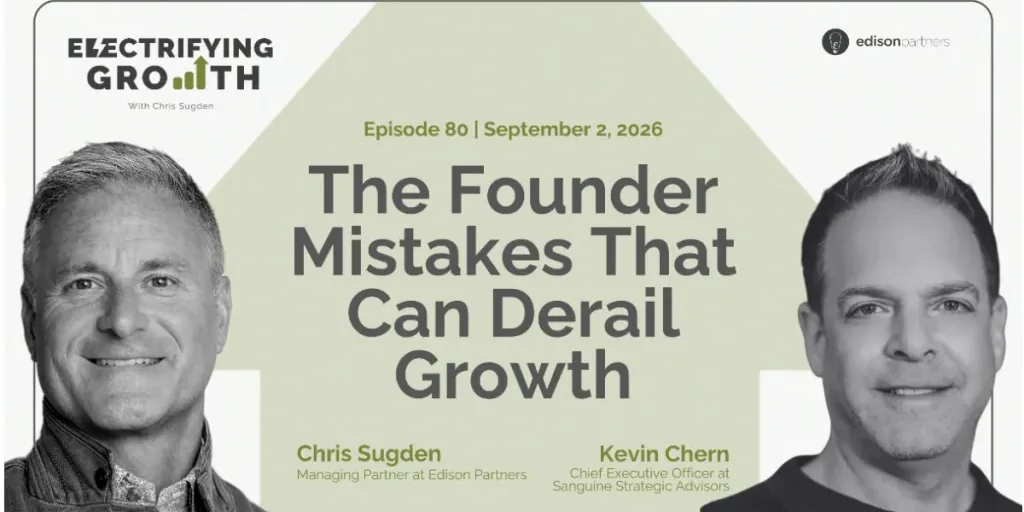

Kevin Chern on the Founder Mistakes That Can Derail Growth
Jordan Wood
Every founder makes mistakes. The challenge is knowing which ones become useful lessons, and which can permanently change a company’s trajectory.
On Electrifying Growth with Chris Sugden, Kevin Chern reflected on his path from attorney to entrepreneur and the high-stakes decisions that shaped it. From scaling law firms and navigating regulatory battles to choosing investors and hiring executives, those experiences ultimately inspired Sanguine’s mission: helping business owners avoid costly mistakes when the stakes are highest.
From Attorney to Entrepreneur
Kevin’s journey to entrepreneurship started long before he launched his first company. Growing up, his father was an entrepreneur, owning several businesses. Early in his career, Kevin worked for an attorney who ran a high-volume bankruptcy firm like a business. That experience changed how he viewed law firm growth. He saw that a legal practice could be built with the same discipline, marketing, operations, and scale as any other business.
When he decided it was time to go out on his own, Kevin carried that model with him. What started as a two-person team in Chicago grew quickly, turning into 180 people across 22 states. Along the way, he began using cross-marketing and referral relationships to grow the business. That experience became an early lesson in what would shape much of his career: growth does not happen by accident. It happens when founders recognize opportunity, build systems around it, and treat the business as something that can be scaled.
Seeing the Opportunity Before the Market Caught Up
About five years into running his law firm, Kevin saw a new opportunity that changed how he viewed the business: Google pay-per-click advertising. While many firms were still relying on more traditional marketing methods, Kevin recognized that PPC could create a faster, more measurable way to generate demand. He began producing leads at scale and quickly saw the power of data-driven marketing.
Lead volume grew beyond what his firm could handle, so Kevin started selling them to other law firms. He also used the data behind the leads to make smarter business decisions. By tracking where searches came from and where demand was strongest, he could identify which markets had the most opportunity and build around them.
That early move into digital lead generation became a turning point. As the marketing side of the business gained momentum, Kevin realized he was more interested in building growth systems than running the law firm itself. He had seen where the market was moving before many others did, and that ability to recognize openings early became a defining part of his entrepreneurial path.
The Mistakes That Can Change a Company’s Trajectory
When Kevin turned the lead generation side of his law firm into its own company, he learned lessons that would shape the rest of his career. At first, the company was doing well, but two major decisions changed its trajectory.
The first mistake was choosing the wrong capital partner. An experience that reinforced a lasting lesson: when capital and control are involved, the quality of the partner matters as much as the money.
The second mistake was hiring the wrong CEO. The problem was alignment. At the time, Kevin saw the warning signs but believed the company could overcome them. It wasn’t until the CEO and capital partner sold the company that the full lesson became clear.
Founders have to be careful when pressure, emotion, or outside circumstances affect their judgment. A few low-stakes errors can be overcome. But when the decision involves capital, leadership, control, or the long-term future of the company, founders need a clear process and a clear head. Those decisions shape everything that comes next.
Why Process Matters in High-Stakes Hiring
High-stakes hiring decisions are often made under pressure, when urgency and emotion can cloud a founder’s judgment. Kevin emphasized the value of a defined process and, when needed, objective input from outside advisors who can assess the business and candidates without the same emotional attachment to the outcome.
Kevin pointed to his recent CTO hiring process as an example of a more structured framework. Before starting the search, he and his team defined exactly what quality looked like and what they were looking for. After posting the opening on LinkedIn, they received 750 applicants in an hour. They used an AI model built around their specifications to narrow the pool, then asked remaining candidates to submit a 10-minute video answering questions designed to get at the heart of what the role required.
The video step worked in two ways. First, it helped Kevin and his team better understand the candidates and judge fit. Second, it showed which candidates were willing to put in the effort. If someone wasn’t willing to complete the video, that said something about whether they would fit the company’s culture. From there, the remaining applicants met with a behavioral psychologist, who gave Kevin deeper insight into which candidate would be the strongest fit for the role and the company.
Hiring tools have expanded significantly in recent years, and AI has made it easier than ever to cast a wider net. But that wider net creates new challenges. Hiring well now requires more than finding impressive candidates. It requires a disciplined process that tests fit, effort, judgment, and alignment.
How Those Lessons Led to Sanguine
After exiting his previous company, Kevin was looking for his next move. He started having conversations with small business owners he knew and realized that, through his own experience, he had answers to many of the problems they were facing. But after running several businesses of his own, he didn’t want to get back into the weeds to solve every problem directly. Instead, he started connecting business owners with solution providers he trusted.
At the beginning, Kevin was making these introductions as a goodwill gesture. Companies offered to pay him, but he still held a belief many people mistakenly hold: goodwill and compensation can’t coexist. Over time, he came to two realizations that shaped what came next. First, his network and ability to connect the right people had real value, and it’s not wrong to be compensated for it. Second, vendor selection is difficult for small businesses. They often don’t have the time, money, or margin for error to make the wrong choice, yet many of those decisions are still based on guesswork.
Those ideas became the foundation of Sanguine: helping business owners evaluate and connect with trusted solution providers, so important vendor decisions are based on fit and experience rather than guesswork.
Make the Small Mistakes, Avoid the Big Ones
Kevin’s message isn’t that founders should avoid every mistake. He said, “I’ve come to learn that it’s ok to make a lot of little mistakes, just don’t make the big ones.” Small mistakes are part of building a business, and often become the lessons that sharpen judgment over time.
The goal is to protect the company from decisions that can permanently damage its momentum, control, or future. Choices involving investors, executives, vendors, and growth strategy deserve a disciplined process, outside perspective, and a clear understanding of what is at stake.
Tags:
TRENDING POSTS

How Law Firms Harness the Power of AI

Your January Business To-Do List That Can’t Wait Until February