


My Day with Debra: Lessons in Leadership
Posted February 13, 2026 by Kevin Chern
My Day with Debra Sunderland: Lessons in Leadership
Yesterday I spent time in a leadership discussion led by business coach Debra Sunderland, and I left with that rare combination of feelings leaders chase: grounded, challenged, and oddly energized. Not because I got a new “system” or a shiny set of tactics, but because Debra kept pointing us back to something deeper.
She talked about the invisible parts of leadership that quietly drive the visible outcomes we all care about.
Revenue. Culture. Retention. Execution. Trust.
And it hit me: most of what blocks our results is not a strategy problem. It is a pattern problem.
Bigger results correlate to who you are becoming
Debra opened with a simple but uncomfortable truth: bigger results correlate to who you are becoming. Not what you know. Not what you intend. Not what you’re busy doing.
That framing immediately shifted the room.
It is easy to default to “What do we need to do next?” Debra kept steering the question toward: “Who do I need to become to create the results I want?”
That is a more personal question. And it is also a more powerful one, because it forces you to look at the internal patterns running your leadership on autopilot.
The shift: from judgment to feedback
One of the most helpful things she said (and one I plan to repeat to myself) was this:
When you get an outcome you do not want, it does not mean something is wrong with you. It means a pattern was running on autopilot.
That is a different posture entirely.
Instead of treating unwanted outcomes like failure, she reframed them as feedback. As information. As something you can get curious about. That sounds small, but it is not.
Because when leaders treat outcomes as personal failure, they tighten. They control more. They blame more. They spiral.
When leaders treat outcomes as feedback, they learn. They adapt. They lead.
A common leadership blind spot: stepping in “without being asked”
Debra named a pattern I have seen across nearly every team I have ever worked with, including my own: a leader wants a result, someone else is responsible for delivering it, and then anxiety rises.
So the leader steps in.
Not because they are trying to be a problem. Often because they care, because they are responsible, because they want excellence.
But the message received by the team is simple:
“I don’t fully trust you.”
And when people feel that, sometimes even subtly, performance drops. Creativity shrinks. Ownership diminishes. High potential stays hidden.
That was a gut check for me, because stepping in can feel like leadership in the moment. But if it reduces trust and ownership, it is not leadership. It is control wearing a leadership costume.
The Three Lanes (and why leaders get exhausted)
Debra described responsibility as three lanes:
My lane. Your lane. The Universe’s lane.
And she made the case that a lot of leadership stress comes from living in someone else’s lane.
When we step into someone else’s lane:
- We take on responsibility that is not ours.
- We exhaust ourselves.
- We limit other people’s growth.
- We create confusion and conflict.
- We lose clarity of our own role.
For CEOs and senior leaders, that last part matters more than we like to admit. Because the true role is not to control every action.
It is to steer the ship.
To hold the vision.
To guide direction.
To create conditions where others can rise.
When leaders stay in their lane, trust expands. Teams grow stronger. Culture gets healthier. Innovation increases. And revenue has room to scale.
Invisible Wins: the pause that changes everything
Debra’s phrase for what she is really teaching is Invisible Wins, the internal shifts that create sustainable business growth.
She said something that stuck with me: invisible wins happen when leaders pause, breathe deeply, notice the urge to control, and choose trust instead.
That single internal shift, unseen by most, often produces the most visible external breakthroughs.
And it is a practice.
Noticing “I am not in my lane” is a win.
Noticing “I am about to react” is a win.
Noticing “I’m grasping for certainty” is a win.
Because noticing gives you choices. And choices are where leadership lives.
Above the line vs. below the line
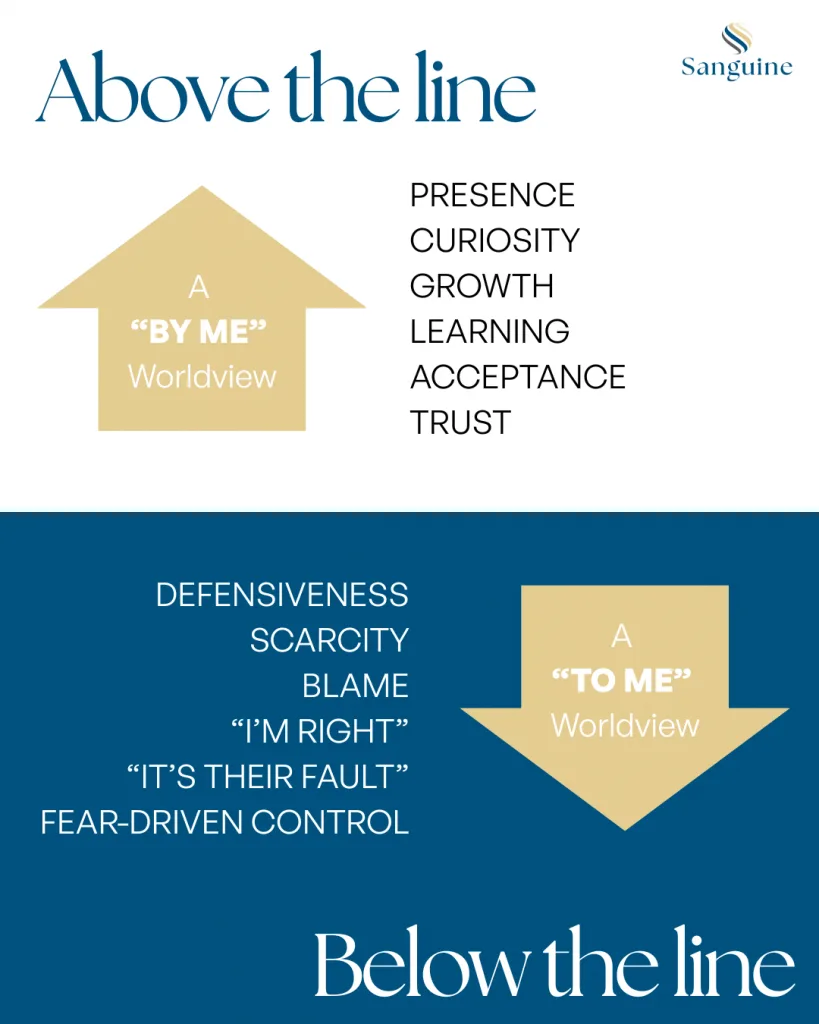
Another framework Debra shared was “Above and Below the Line.”
Above the line is a “by me” worldview.
Below the line is a “to me” worldview.
Above the line looks like:
- presence
- curiosity
- growth
- learning
- acceptance
- trust
Below the line looks like:
- defensiveness
- scarcity
- blame
- “I’m right”
- “It’s their fault”
- fear-driven control
She offered practical ways to climb back above the line, and one of the most deceptively simple: breathe (literally, three deep breaths) before responding.
It sounded almost too basic, until she connected it to something every leader knows is true: organizations mirror the emotional tone of leadership.
If leadership is reactive, the organization becomes reactive.
If leadership is calm and present, teams become more resilient and more innovative.
Collaboration over control
Debra drew a sharp line between control and collaboration:
- Control produces compliance.
- Collaboration produces ownership.
- And ownership is what you want if you want scale.
When people feel heard and respected:
- innovation increases
- engagement rises
- retention improves
- accountability becomes shared
That last phrase, shared accountability, landed for me. Leaders carry plenty. But the goal is not to carry everything. The goal is to build a culture where responsibility is distributed, where people rise, and where leadership is not the bottleneck.
Trust is not soft. It is infrastructure.
Debra said something I wish every executive team would print and hang somewhere visible:
Trust is not a soft skill. It is a business multiplier.
High-trust cultures move faster, with less bureaucracy. They create better customer experiences. They build loyalty. They make better decisions. They produce stronger results.
And trust reduces the hidden tax of politics and fear.
That framing matters because most leaders do not wake up thinking, “How do I create fear today?” But leaders do unintentionally create fear when they over-control, override, or constantly step into other people’s lanes.
Trust is built through presence, clarity, and impeccable agreements. Not through intensity.
Long-term orientation: decades, not quarters
Debra also pressed us to zoom out.
- Short-term, reactive thinking creates pressure, overwhelm, and defensiveness.
- Long-term, curious thinking creates stability and new realities.
Leaders who think long-term ask:
- What legacy are we building?
- What kind of culture are we known for?
- Are we developing people, or just extracting performance?
That last question is a leadership mirror. And it is one I plan to keep close.
What I’m taking with me
I left with plenty of notes, but a few commitments felt non-negotiable:
- Treat unwanted outcomes as feedback, not failure. Get curious. Find the pattern.
- Stay in my lane. Steer the ship. Create conditions. Do not crowd out other people’s capability.
- Practice the pause. Breathe before responding. Choose trust over control.
- Build trust as infrastructure. Not as a vibe. As a deliberate operating system.
- Lead for the long term. Build people and culture, not just output.
Why I recommend Debra
- If you are a leader who is successful on paper but tired in your bones, Debra’s work will land.
- If you have a strong team but can feel that trust, ownership, or initiative is not fully unlocked, Debra will help you see the pattern.
- If you are winning externally but feel like something is missing internally, Debra has a way of naming what is going on without judgment, then giving you a practical path forward.
Debra Sunderland is the real deal, and I would recommend her to any founder, CEO, or leadership team that wants to “up their game” in a way that actually sticks. You can learn more about her work at https://sunderlandcoaching.com.
For me, the biggest takeaway was simple:
The most powerful wins in business are often unseen.
And if you can create the unseen wins, the visible wins become inevitable.
Tags:
TRENDING POSTS

How Law Firms Harness the Power of AI

Your January Business To-Do List That Can’t Wait Until February